Food Chains. Small bridges between what your child eats now and something you'd love to share.
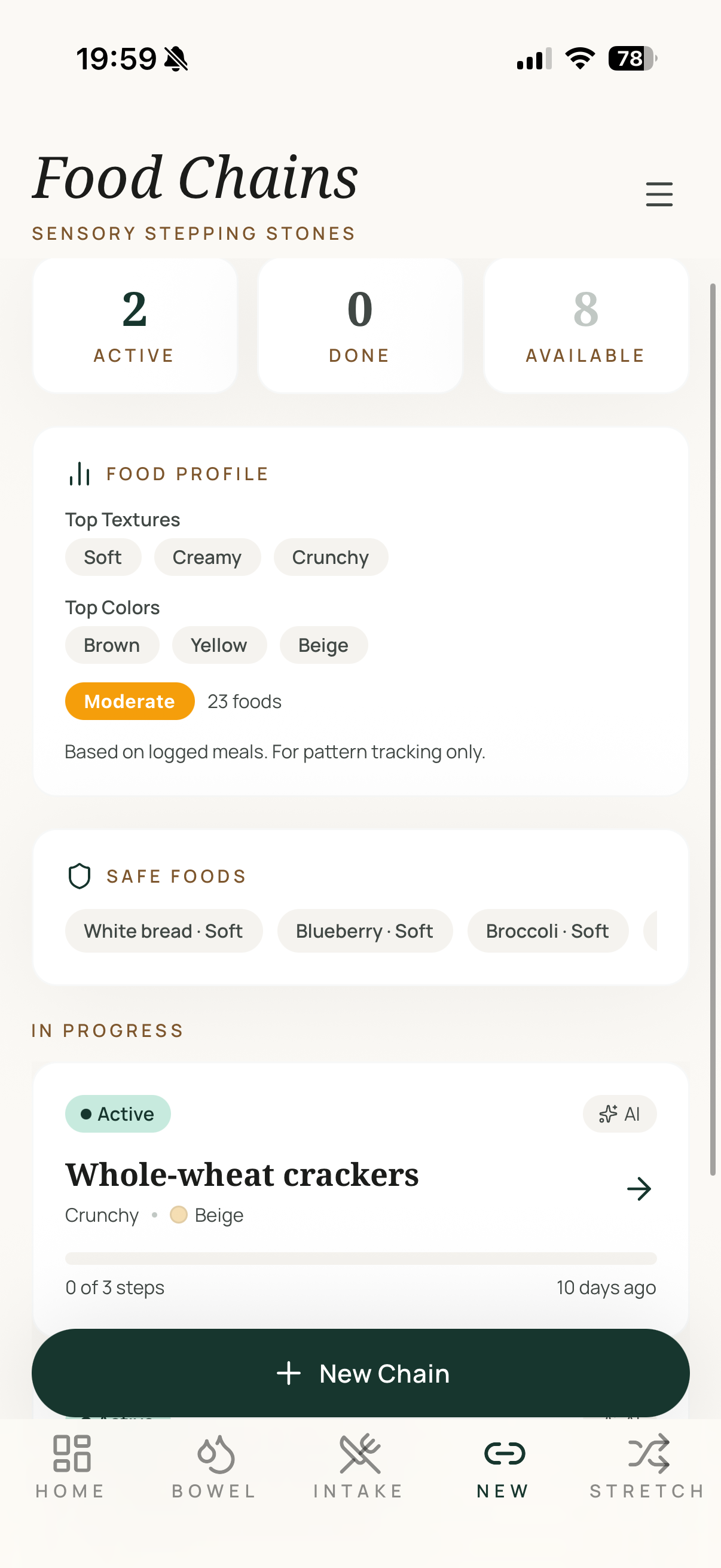
A Food Chain is a sequence of small, tolerable steps from a food your child reliably eats to a food you'd love them to try one day. Galet suggests the stepping stones. You choose which ones fit, change them, or skip them.
How a chain comes together.
Say your child eats buttered toast. You'd love them to try grilled cheese. A Food Chain might look like this:
Six steps. Each one changes a single sensory variable from the last. Your child's nervous system gets a small, predictable bridge. Not a leap.
You don't have to walk the whole chain. Most families stop partway. That's fine. The chain isn't a target. It's a menu.
AI suggests. You decide.
Galet uses Gemini (Google's language model) to propose stepping-stone sequences based on the safe foods you've shared and the target food you'd like to bridge toward. Then it gets out of the way.
- What the AI does. Proposes a sequence of small sensory bridges. Nothing more.
- What the AI doesn't do. It doesn't diagnose, treat, or predict outcomes. It doesn't see your child. It doesn't know your child's medical history, allergies, or sensory triggers. You do.
- Your role. Review every suggestion. Edit any step. Skip any step. Discard the whole chain if it doesn't fit. You're the expert on your child.
- Our CMO's role. The prompting framework has been reviewed by our paediatric GI CMO, with guardrails against clinical claims and treatment-style language.
The frameworks behind Food Chains.
Food Chains draw on three bodies of work in pediatric feeding:
- SOS (Sequential Oral Sensory) approach. The idea that children often need to experience a food across many sensory levels (look, touch, smell, taste) before they're ready to eat it. We don't replicate SOS clinically. We borrow the principle that sensory familiarity precedes acceptance.
- Food chaining (Fraker et al.). A feeding-therapy technique that bridges from accepted foods to target foods through shared sensory properties. Our chains use this logic in a home-friendly form.
- Just-Noticeable-Difference (JND). The sensory-science principle that the smallest detectable change is the largest change most sensory systems can tolerate. Each step in a chain aims to sit at or below that threshold.
These frameworks are clinician-led when they're delivered inside therapy. Inside Galet, they're a parent-led planning aid. That difference matters. We name it clearly.
A few things we want to be direct about.
- Food Chains are not a substitute for feeding therapy with a trained clinician.
- They don't predict whether your child will accept any given step.
- They're not evidence that Galet "works." They're one tool a parent might use.
- AI can suggest a step that's wrong for your child. That's why you review before you try.
Build your first chain.
Our Toronto pilot is open to 15 families. You'll get full access to Food Chains, and a direct line to us when something doesn't feel right.
Learn about the pilot