One score, built from three signals.
What your child ate. How hydrated they were. What their digestion looked like. Galet brings the three together into a single Gut Score, so you can see patterns most parents never get to see.
Nobody else looks at food, hydration, and digestion as one picture. We think that's a miss. The same kid, the same week, the same body — and the signals belong together.
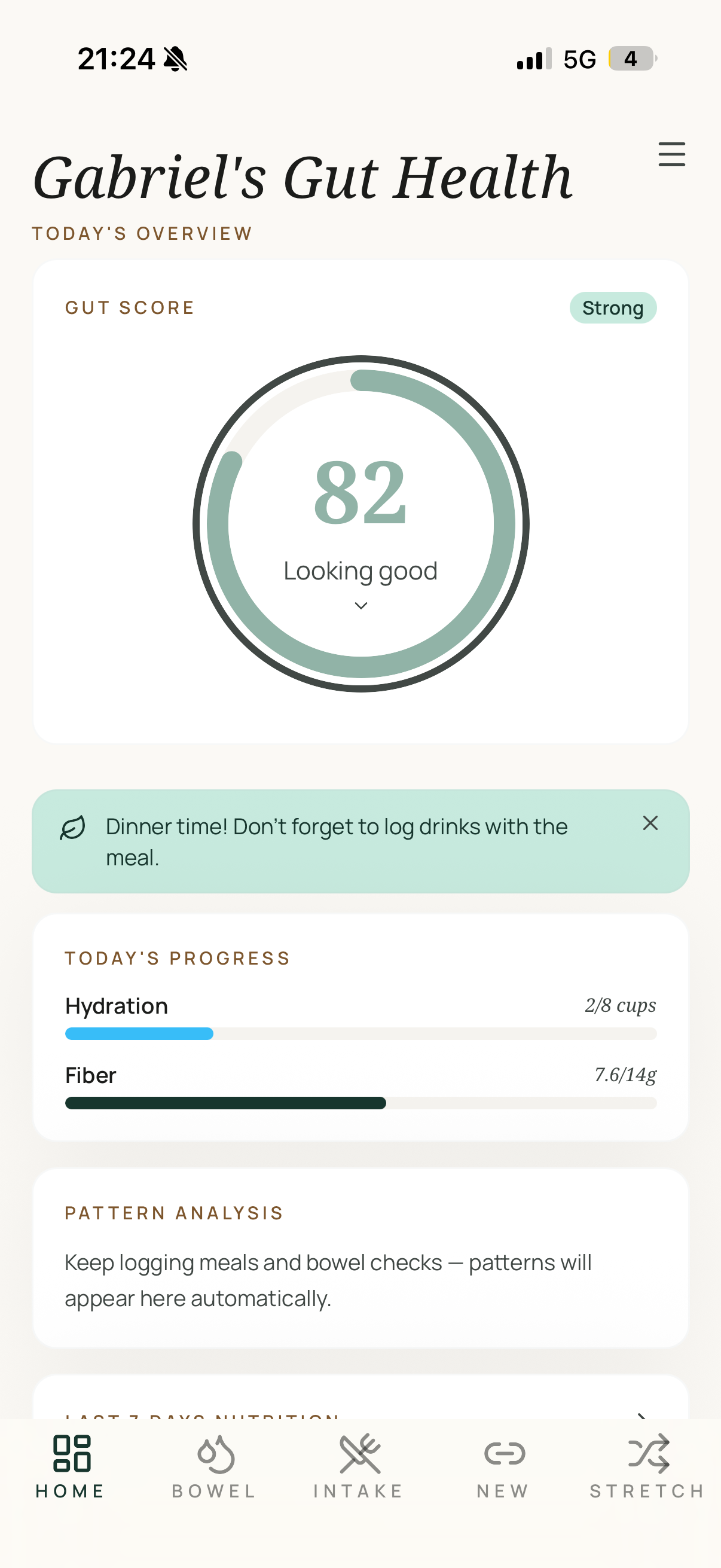
A descriptive summary. Not a grade.
Most tracking apps give you a number for calories or a score for "nutrition." We do something different. A Galet Gut Score looks at three things together: what your child ate, how hydrated they were, and what their digestion looked like. When those three move together, you start to see patterns a food diary alone would miss.
The score goes up when the signals point in the same direction. It sits still when nothing has changed. It shifts when something is worth noticing. That's it.
Food helps bowel. Bowel helps food.
The pattern some families start to see, once the three signals live on the same page.
More variety lands.
As the safe-food list widens, fibre tends to come along.
Digestion feels easier.
Fibre and hydration often bring gentler, more regular patterns.
New food feels smaller.
When the body feels easier, trying a new food is less high-stakes.
More variety lands.
And the loop starts over. Quietly. At your child's pace.
Three signals. Plain sources.
Meals & nutrition
Fibre, iron, calcium, protein. Tracked against Health Canada Dietary Reference Intakes (DRIs) for your child's age. Reference ranges, not prescriptions.
Hydration
Water, milk, juice, broth, and the water in food. Age-appropriate pediatric guidelines. Juice and sugary drinks flagged gently.
Digestion
A pediatric-adapted Bristol Stool Scale. The same visual scale feeding teams and GI clinics use. One tap a day. Skip a day. No pressure.
Log in seconds. See patterns in weeks.
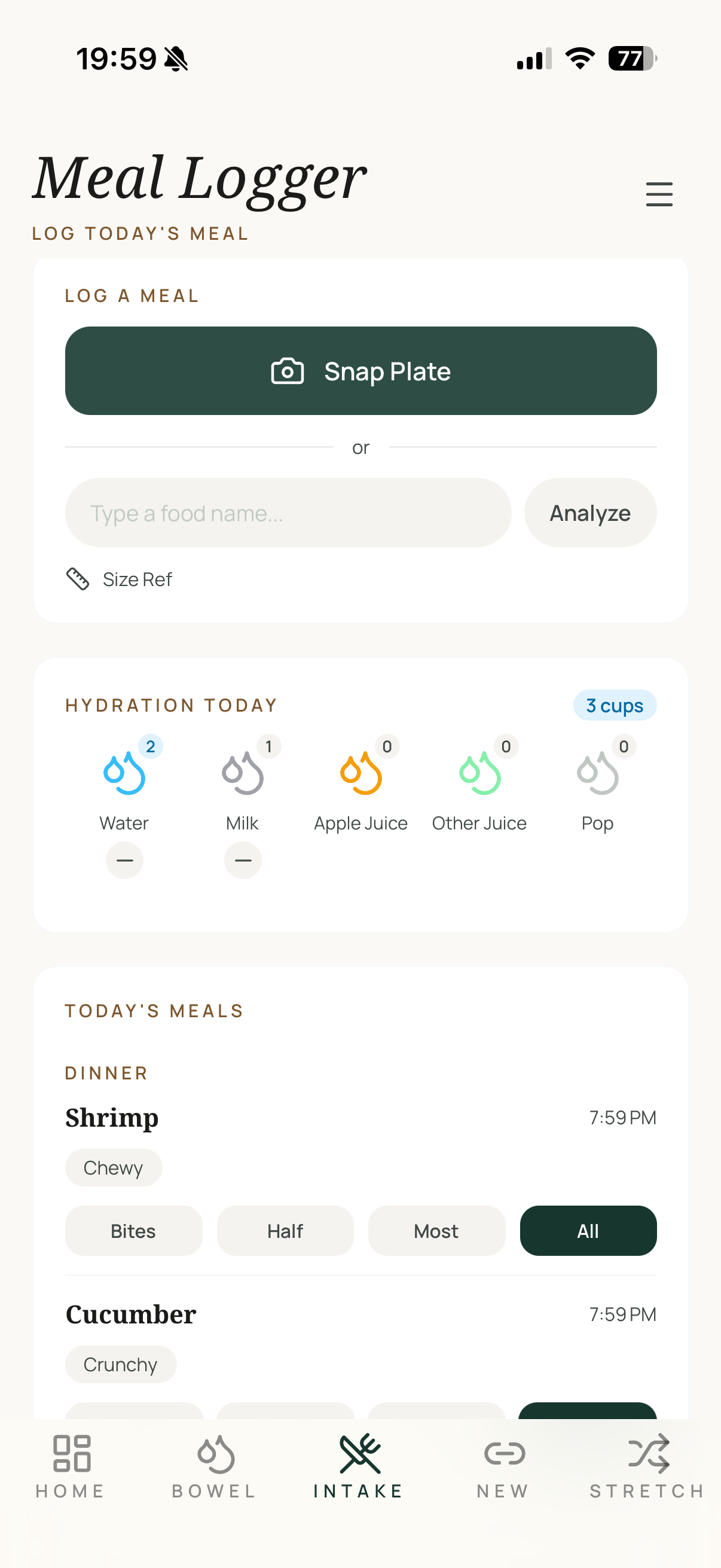
Tap a meal with your camera, or type a name and let Galet's food library fill in the rest. Log hydration in one swipe. Log a Bristol type in one tap. That's the whole daily job — a minute or two at a time.
Over weeks, Galet shows you what your child's baseline looks like, and flags when a pattern changes. Not every day needs a log. A week with gaps still tells a story.
What the Gut Score is grounded in.
Every signal the Gut Score uses draws on published pediatric frameworks. Full citations and notes on our Clinical evidence page.
Nutrition reference ranges
Age-specific ranges for fibre, iron, calcium, protein, and hydration come from Health Canada's Dietary Reference Intakes (DRIs), the Institute of Medicine DRI series, and position statements from the Canadian Paediatric Society.
These are general population references, not individual prescriptions. Many healthy children live outside them.
Bristol Stool Scale
The descriptive scale for digestion comes from Lewis & Heaton (1997). The pediatric adaptation we use draws on Lane et al. (2011), which validated a modified Bristol scale for children.
Lewis, S. J., & Heaton, K. W. (1997). Stool form scale as a useful guide to intestinal transit time. Scandinavian Journal of Gastroenterology, 32(9), 920–924. Lane, M. M., et al. (2011). Reliability and validity of a modified Bristol Stool Form Scale for children. The Journal of Pediatrics, 159(3), 437–441.e1.
Food Chaining (for Food Chains)
The sensory-bridge logic behind Food Chains draws on the published food-chaining literature. See PubMed 16556929 and Fraker et al. (2007), Food Chaining: The Proven 6-Step Plan.
Fishbein, M., Cox, S., Swenny, C., Mogren, C., Walbert, L., & Fraker, C. (2006). Food chaining: a systematic approach for the treatment of children with feeding aversion. Nutrition in Clinical Practice, 21(2), 182–184.
The feeding-gut connection
The observation that feeding behaviour and gut patterns travel together in neurodivergent children is supported by Sharp et al. (2013), Margolis et al. (2019), and McElhanon et al. (2014). Full citations on the Clinical evidence page.
What the Gut Score isn't.
- Not a diagnosis. Not for ARFID, autism, ADHD, constipation, IBS, food allergies, or failure to thrive.
- Not a percentile. It doesn't compare your child to other children.
- Not a grade of your parenting. A lower score doesn't mean you're doing worse. It means something is worth looking at.
- Not a medical device. Galet sits outside SaMD scope. See our SaMD disclaimer.
See your family's Gut Score.
Free during the pilot. Core tools stay free forever.
Learn about the pilot